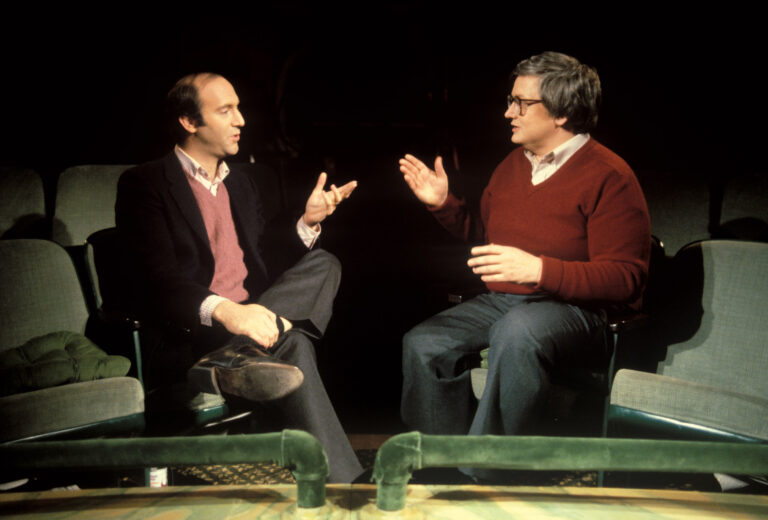
In the fall of 1981, Roger Ebert and Gene Siskel fell in love with two men named Andre and Wally, and they told the world about it, thereby saving a tiny, eccentric, beguiling movie from a fast fade into commercial oblivion. I went to that movie, as did a few hundred thousand or more other people, because of that love.Â
At the time their show went by the handle “Sneak Previews,” soon to be renamed “At the Movies” when the PBS success moved to a national syndication deal at Tribune Entertainment and then to Buena Vista Entertainment, aka Disney/ABC. The film about Andre and Wally, director Louis Malle’s “My Dinner with Andre,” made for perfect undergrad viewing, at least my undergrad viewing. Big ideas, elaborate anecdotes, two friends in real life: The struggling playwright and performer Wallace Shawn and the adventurous, restless experimental theater guru Andre Gregory, sharing a meal and a few insights. The movie feels like a play you’re watching from the next table, or from an ever-present waiter’s proximity.
When “My Dinner with Andre” opened, it was barely there. In Opposable Thumbs, Matt Singer’s book on the enterprising enterprise known as Siskel & Ebert, Shawn recalls the film eking out an unpromising handful of screenings at the Lincoln Plaza Cinema in New York City, before the film’s distributor started running miniscule ads saying, in effect, “closing soon in a theater near you, if it happens to be playing in a theater near you.”Â
And then Roger and Gene’s “Sneak Previews” episode aired on a Thursday. The sellouts began, and “instead of closing,” as Singer writes, the film “stayed at the Lincoln Plaza Cinema for a year straight, and it wound up playing in more than nine hundred theaters all over the United States.” It cost a little under $500,000 to make it. It grossed roughly ten times that.Â
I saw it at the Cedar Theater on the West Bank of the University of Minnesota Twin Cities campus, the same theater where I caught a midnight showing of “Eraserhead” as a freshman and never fully recovered. “My Dinner with Andre” was verbose in an easy-listening way, and exactly the sort of movie I wanted at that age, when I was discovering the joys of what the U of M theater majors (I was just a hanger-on) called “the pointless second dinner after rehearsal,” an excuse for hours of rudderless, ridiculous, eddying late-night conversation.
This is what Roger and Gene were about, in miniature, and without the “ridiculous” part, some of their sweaters aside. Before I read either of them, I listened and watched them converse, and debate, sometimes pissily, yes, more often thoughtfully, always engagingly. I saw “My Dinner with Andre” because it had champions in Roger and Gene, and my first film critic crush, Pauline Kael, whose essay “Trash, Art and the Movies” was excerpted in my seventh-grade textbook, Coping with the Mass Media. In its “Sneak Previews” era, the show was so, so simple and so right, one of those unassuming comets that comes around every 76 years or so. What they said, and how they said it, mattered to so many.Â
The summer before “Sneak Previews” saved “My Dinner with Andre” from flopdom, I worked a part-time janitorial job at a machine parts factory in northeast Minneapolis. The guys in the shop talked about movies a lot. “Took my kid to see “Cannonball Run,” the friendliest of the guys told me over break. “Just, you know, stupid. But fun. And that Adrienne Barbeau. I mean! Cripes. Wouldn’t kick her outta bed. I watched ‘Maude” every week because of her, and I HATED ‘Maude.’ I kinda liked ‘Cannonball Run.’ (pause) (laughing) And Roger and Gene HATED that one!”Â
My factory cohort watched “Sneak Previews” every week. He saw his first subtitled film because Roger and Gene recommended it. I wish I knew which film it was, but whatever it was, he took a chance on it based on loyalty to “my guys,” as he called Roger and Gene. Based on where most of the populist imports were coming from at the time, my coworker may have taken that chance because the film was either French or Italian, and one of the female leads may have resembled Adrienne Barbeau. But the nudge came from a couple of film critics.
This sort of thing happened a lot along the years of their TV run, the 50th anniversary of which Chicago celebrates this year.Â
I never knew Gene; I knew Roger, and, through Roger, I have a valiant, good friend in Chaz Ebert. When Roger got sick, somehow, improbably, there I was, in 2006, in the Ebert chair (gulp) opposite longtime co-host Richard Roeper, trying to say something quick and interesting before wait the segment’s over already well better luck next segment.That somehow improbably turned into a steady rotation with A.O. Scott of The New York Times opposite Richard, and then Richard and me for a time before Richard left, and Tony and I ran out the syndication contract for the show’s final year.Â

When I was floundering, which was early and often, Roger more or less saved my ass with a couple of very simple tips:
One: Figure out the ONE THING you NEED to say about whatever you’re reviewing in the time you have on camera. Maybe two things. But really, one. Don’t try to cover the waterfront. You will drown.
Two: There are ways to interrupt or, more politely, interject, without speaking. Whatever physical thing you tend to do in real life when you hear somebody say something worth an argument—shaking your head or doing some “waaaaait a minute” thing with your hands—just do that, but bigger than you’d do it in actual life. Do that thing, and the camera will cut to YOU. And then you talk, quickly.Â
“Time is short,” Roger told me. He was referring to the segment’s unscripted cross-talk, which made the show the show. Now that he and Gene have been gone a long time, even though they’re with us still, I realize he may have been talking about something larger than effective on-camera debate tactics.Â
As Chicago marks the 50th anniversary of these two, let’s also remember why we watched, listened to, and read them in the first place. The thumbs weren’t the thing, really. What I remember about Roger and Gene talking up “My Dinner with Andre” was the excitement of discovery.
At their best, like Andre and Wally with a different, itchier sort of friendship underneath the double act, Gene and Roger made the connections and started new conversations (or arguments) about movies we’d seen–and the ones we’d be seeing that weekend, thanks to them.
gentongfilm
Agen Togel Terpercaya
Bandar Togel
Sabung Ayam Online
Berita Terkini
Artikel Terbaru
Berita Terbaru
Penerbangan
Berita Politik
Berita Politik
Software
Software Download
Download Aplikasi
Berita Terkini
News
Jasa PBN
Jasa Artikel
Related Posts
“Pokemon: Legends Z-A” is Several Steps Forward, Several Steps Back | Video Games
[ad_1] The Pokemon series has been in need of serious…
Effective Second Season of “Peacemaker” Proves the Future of the DCU’s TV Slate is Bright | TV/Streaming
[ad_1] More than three years after the titular character appeared…
Disney’s Snow White | Review
[ad_1] ★★★ Somewhere between ‘poisoned apple’ and ‘fairest of them…